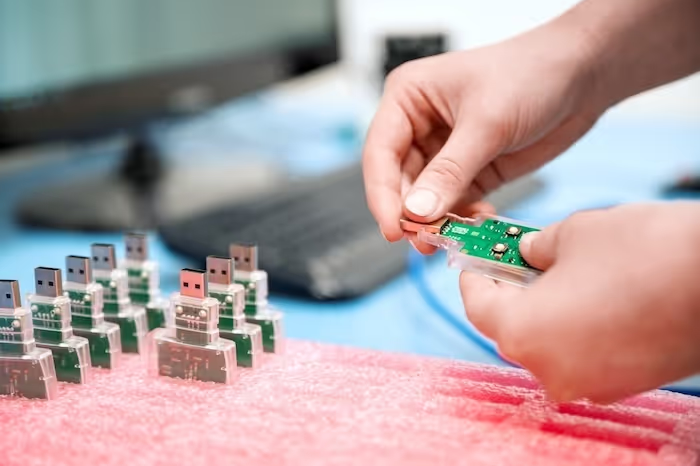
Extending TempMonitor BLE to Ultra-Low Temperatures

Introducing the new TSS Dry Ice Probes, enginereed for accurate and GxP-compliant temperature monitoring down to –90°C. Available in two lengths for flexible setup — built to safeguard product integrity in every environment.
Product Announcement

We’re excited to introduce the new Dry Ice Probe, extending the capabilities of TempMonitor BLE (TMBLE) to deliver complete visibility and control in ultra-low temperature applications.  

“Pharmaceutical and clinical supply chains depend on precision at every stage,” says Johanna Eriksson, Chief Product Officer at TSS. “With the new Dry Ice Probes, we’re extending the proven reliability of TempMonitor BLE into ultra-low temperature applications — giving our customers complete visibility and control over product integrity, even in the most demanding conditions.”

Built for Compliance and Scalability

The probe is available in two cable lengths, 100 mm and 300 mm, and deliver accurate and GxP-compliant temperature monitoring from –90°C to –30°C, ideal for pharmaceutical materials stored on dry ice. Designed with a stainless-steel probe and durable Teflon cabling, it ensures reliable performance and long-term stability in demanding ultra-low temperature environments.

Each probe features a PT100 temperature sensor for high-precision readings and is ISO 17025 calibrated to ensure verified performance. The plug-and-play design connects seamlessly to TempMonitor BLE, instantly converting analog readings into validated digital data — streamlining temperature monitoring without the need for additional setup or configuration.

Real-Time Data and Visibility

Through the TSS Gateway, data is securely transmitted to the TSS Cloud, providing real-time visibility and alerts in the TSS Facility and Clinical SaaS Modules. This ensures full data integrity, reduced manual handling, and faster decisions — from storage to shipment.


You may also be interested in

Automation is making temperature excursion management simpler and more efficient for clinical sites

Are healthcare professionals working at clinical sites across the world satisfied? It might seem like a strange question to ask, but the way we feel can impact our professional performance in important ways. Perhaps the question is not how satisfied Clinical Operations professionals are, but whether they feel their performance is impacted by lots of time-consuming manual processes that could benefit from automation? Are these processes hampering clinical trial performance?
Read moreDownload Whitepaper

Data-driven supply chains: improving your excursion rate and temperature performance in 5 steps

Data is an essential requirement for improving supply chain processes. But that doesn’t mean that simply collecting more of it will instantly lead to reductions in waste, increases in efficiency and lower excursion rates. Taking a more targeted approach will help you turn supply chain data into insights that can help you understand exactly what is happening at every stage of your pharmaceutical supply chain.
Read moreDownload Whitepaper
A futuristic, digital illustration of a pipette adding a drop of liquid to test tubes, representing advanced technology in clinical trial management.

Boost value in clinical trial management with two-way integrations

Two-way integrations between IRT and the temperature system unlock cold chain consistency in clinical development – protecting patients, maximizing value and minimizing operational costs.
Read moreDownload Whitepaper

You may also be interested in

TSS Sponsors the 27th Annual Clinical Trial Supply Europe 2026 in Barcelona

TSS is proud to sponsor the 27th Annual Clinical Trial Supply Europe, taking place 24–25 February 2026 in Barcelona, Spain. The event brings together clinical supply professionals, sponsors, CROs, and solution providers to discuss how to strengthen resilience, quality, and patient safety across the clinical trial supply chain.
Read more

Can You Rely on the Results from Your Clinical Trials?

The success of a clinical trial depends on the reliability of its data. Many investigational drugs are sensitive to temperature, and any temperature deviation can affect their quality and, in the worst case, patient safety. Automated and integrated temperature monitoring solutions help secure data quality, support compliance, and speed up the delivery of new medicines to patients.
Read more

Subscribe to our newsletter

Sign up for our newsletter to receive all the latest TSS news and insights in temperature management solutions.